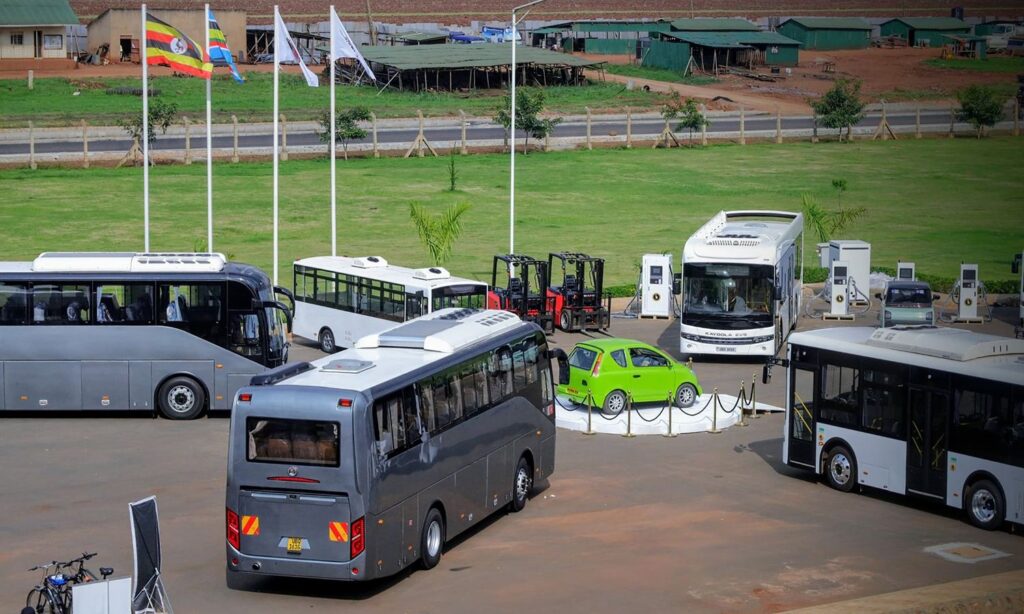
Uganda’s Kiira Motors Corporation has sealed a contract to supply 820 electric buses to South Africa in a deal worth $250 million (about UGX 930 billion), the biggest export agreement in the state-owned company’s history.
Minister of Science, Technology and Innovation Dr Monica Musenero Masanza broke the news this week, saying the signed export contracts mark a turning point for Uganda’s automotive industry.
“This is proof that Africa is ready to build a sustainable, integrated continental economy driven by science, technology and innovation,” she said.
The minister did not name the specific South African companies that placed the orders but said they followed the successful completion of the Kayoola E-Coach’s 7,125-kilometre expedition from Kampala to Cape Town in late 2025.
The journey, which Kiira Motors dubbed the “Made in Uganda Grand Trans-Africa Electric Expedition,” took the Kayoola E-Coach through six countries, namely Uganda, Tanzania, Zambia, Botswana, Eswatini and South Africa. The trip was designed to show potential buyers across the continent that a bus built in Jinja could handle the real demands of African roads, weather and terrain.
It worked. By the time the bus rolled into Johannesburg during the expedition, South African transport operators had already committed to buying 450 units. When the dust settled after Cape Town, the final tally came to 820 buses.
The bus recorded an energy efficiency of 0.84 kWh per kilometre across the journey, a figure Kiira Motors says made the commercial case for buyers.
“7,125 kilometres conquered. 820 buses sold. The expedition has redrawn the map of African industry,” the company said.
Kiira Motors will fulfil the contract working alongside Tondeka Metro, RentCo Africa and technology partner Golden Dragon. The group is targeting production of 30,000 buses for the regional market by 2030 and wants to source 65 percent of parts and components from within Uganda.
Delivery of the South Africa order is expected to take between six and twelve months.
However, Musenero was candid about the funding challenge ahead. The corporation is looking for an additional $143 million to finance production at the scale the contract demands. While most raw materials are being sourced locally, some inputs like automotive steel and specialised paints still have to be imported.
Kiira Motors was set up to turn Uganda’s homegrown electric vehicle research into a real industry and chip away at the country’s $795 million annual vehicle import bill. The Office of the President holds 96 percent of the company and Makerere University holds the remaining four percent.
In the 2024/2025 financial year, government put in UGX 32.5 billion to help complete the manufacturing facility at Jinja Industrial and Business Park. When fully operational, the plant is expected to turn out up to 2,500 vehicles a year.
The Kayoola E-Coach at the heart of this deal is a 13-metre inter-city bus with a maximum power output of 400 kW, a torque of 5,000 Nm, and a range of 500 kilometres on a single charge. It seats 64 passengers.
Critics in Parliament have in the past questioned whether producing buses locally is cost-effective compared to importing, but a near-trillion-shilling export deal to one of Africa’s biggest economies goes some way toward answering that question.
All eyes now turn to Jinja, where the buses will be built, and to whether Kiira Motors can deliver on time and at the scale South Africa is expecting.
Got a Story, Advert, or Announcement?
Onion accepts sponsored content, adverts, and news tips.
📧 Email: [email protected]
📱 WhatsApp: +256 787888277