
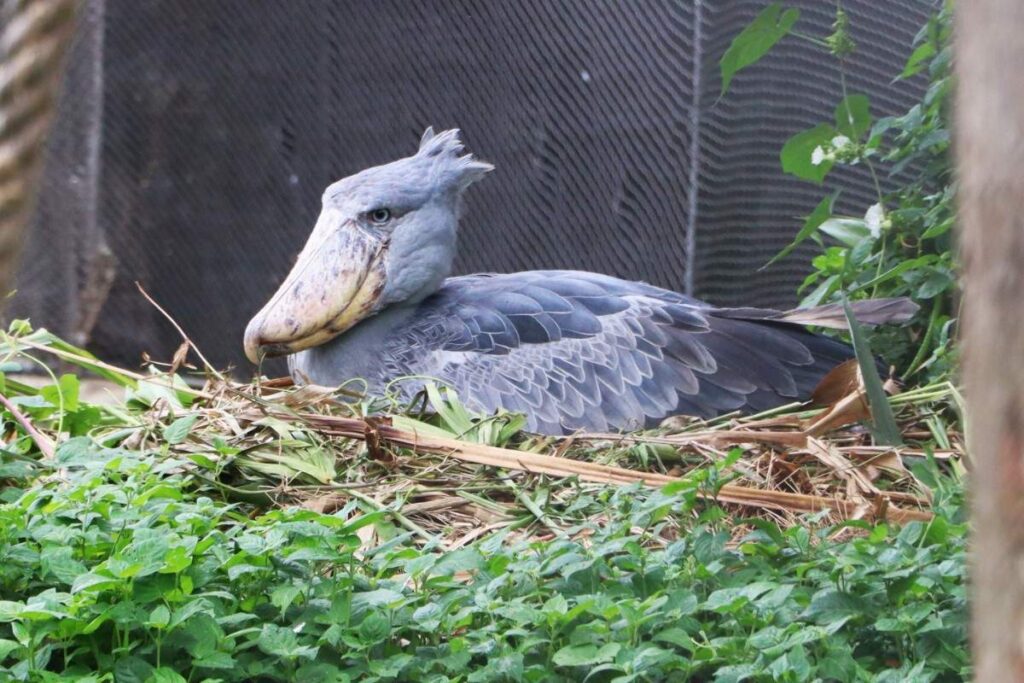
Uganda Wildlife Authority is eagerly anticipating a historic moment as they await the hatching of the very first Shoe bill egg laid in captivity at the Uganda Wildlife Conservation Education Centre – Entebbe Zoo. Today, March 9th, marks the 39th day of incubation, according to Assistant Animal Keeper Hannington Bulemu, who monitors the progress daily.
Typically, Shoe bill stork eggs incubate for 30 to 35 days, averaging about one month. Both parents share incubation duties, taking turns sitting on their clutch of one to three eggs. In captivity, however, the incubation period can extend to around 45 days, as documented in 2008 at Pairi Daiza in Belgium, where the first captive Shoe bill successfully hatched.

The length of incubation varies depending on environmental factors, parental behavior, and the timing of egg-laying. When multiple eggs are laid several days apart—a process called asynchronous hatching—parents may begin incubating before all eggs are laid, causing the eggs to hatch on different days rather than simultaneously.

Both Shoebill parents share incubation responsibilities and actively cool the eggs by wetting them with water from their beaks. Occasionally, inconsistent care such as leaving the nest unattended (egg neglect) occurs; while this doesn’t always impact the success rate, it can affect the incubation duration.
About Shoe bills

The Shoe bill (Balaeniceps rex) is a large, stork-like bird native to East African wetlands, recognized for its enormous, shoe-shaped bill with a sharp, hooked tip used for hunting. They stand 4 to 5 feet tall, with an 8-foot wingspan and have grey plumage.
Shoe bills are monogamous during breeding but are otherwise solitary. They hunt by ambush, remaining motionless for hours before capturing fish, baby crocodiles, and snakes. The IUCN lists them as vulnerable, with an estimated 3,300 to 5,300 individuals remaining in the wild.
They exhibit a unique behavior called urohydrosis, where they defecate on their legs to cool down. Generally quiet, they produce a loud, rattling, machine-gun-like sound with their bills, especially during mating.
Their primary habitats are swamps and marshes. Shoe bills can live up to approximately 35 years in the wild and up to 50 years in captivity.
Got a Story, Advert, or Announcement?
Onion accepts sponsored content, adverts, and news tips.
📧 Email: [email protected]
📱 WhatsApp: +256 787888277