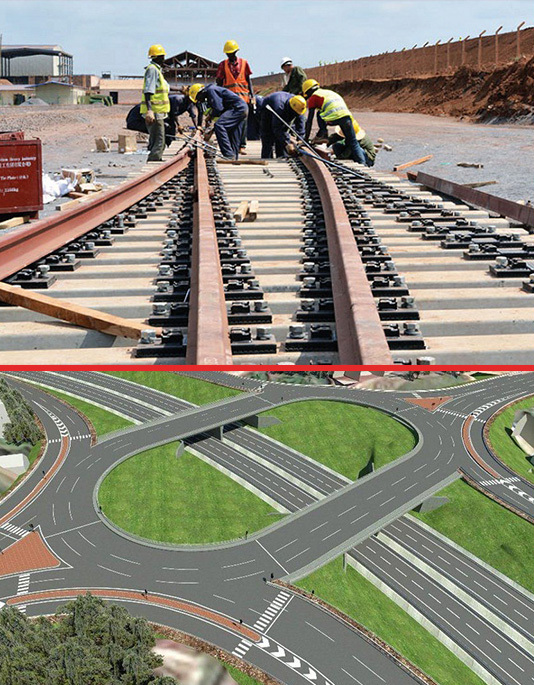
Uganda has allocated Shs8.8 trillion to road and railway development in the 2026/27 financial year, as the government intensifies infrastructure spending aimed at accelerating economic growth and strengthening regional connectivity.
A major focus of the plan is the long-stalled Kira–Kasangati–Matugga Road, a Shs200 billion project that remains among priority road works under the Shs84 trillion national budget. The 23-kilometre route, constructed by Chongqing International Construction Corporation, stretches from Kyaliwajala Trading Centre through Kira and Kasangati to Matugga, with a branch extending to Buwate. President Yoweri Museveni commissioned the project in December 2020, with design features including dual carriageways, five major junctions, and street lighting.
However, the project has faced significant delays, missing its initial January 2024 completion target. By August 2023, progress had reached only 30 percent, prompting public concern over prolonged construction timelines. The latest National Budget Framework Paper for 2026/27 now lists it alongside other major highway projects expected to be completed within the coming year.
These include the 92-kilometre Muyembe–Nakapiripirit road passing through Bugisu and Karamoja, the Tororo–Busia corridor, and the 100.1-kilometre Apac–Lira–Puranga road. Together, they form part of a broader Shs8.79 trillion Works and Transport sector programme.
Works and Transport Minister Fred Byamukama has emphasized the need to clear a growing backlog of incomplete projects, noting that several road works have remained unfinished for four to six years. He specifically pointed to the Mubende–Mityana road and the Jinja Express Highway as projects requiring urgent completion.
Beyond ongoing works, the ministry plans to launch an additional 697.6 kilometres of new roads under the Fourth National Development Plan. These include key routes such as Kayunga–Baale–Galiraya, Katine–Ochero, Muko–Katuna, Jinja–Mbulamuti–Kamuli–Bukungu, Kitgum–Kidepo, Kumi–Ngora–Brooks Corner–Serere–Kagwara, Karugutu–Ntoroko, Rwebisengo link roads, and the Laropi–Moyo–Afoji road, alongside various town roads in Kaberamaido, Kalaki, Jinja, and Ntoroko.
A Shs1 billion road maintenance grant programme will also support rehabilitation works covering 11,000 kilometres of district and community access roads and 2,460 kilometres of municipal and city roads. In addition, routine mechanised maintenance will be carried out on roughly 20,000 kilometres of national roads, including 5,857.86 kilometres of paved roads and 13,350.6 kilometres of unpaved roads. A further 13,844 kilometres will undergo routine manual maintenance, while 1,185.95 kilometres will receive periodic maintenance.
Greater Kampala receives major urban infrastructure boost
The Greater Kampala Metropolitan Area, designated as a Special Planning Area under a Cabinet-approved framework introduced in 2013, is set to benefit from extensive urban upgrades. The plan includes 72.06 kilometres of roads, four markets, and three drainage channels.
Mukono District is expected to receive 59.3 kilometres of roads, two markets, a slaughterhouse, and improved drainage systems. Makindye-Ssabagabo Municipality will benefit from 56.6 kilometres of roads alongside a market and slaughterhouse, while Wakiso, Mukono Municipality, Nansana, Mpigi, Entebbe, and Kira municipalities are also included.
Kira Municipality, recently upgraded in status, is set to receive 46 kilometres of roads and two markets.
Ongoing urban programmes include the Kampala City Roads Rehabilitation Project, the Kampala City Roads and Bridges Upgrading Project, and the Greater Kampala Metropolitan Area Urban Development Programme. The rehabilitation initiative alone covers more than 120 kilometres of roads, including Salaama Road, Spring Road, Old Mubende Road, and sections of the Sir Apollo Kaggwa–Mpererwe–Kiteezi–Kiti corridor. The African Development Bank-funded programme is also expected to roll out improvements in drainage systems, street lighting, and traffic signalisation to reduce congestion and flooding.
Bridge construction and emergency works expanded
The government’s bridge programme continues to prioritize both new construction and emergency rehabilitation works across the country. Emergency repairs are ongoing at Ssezibwa Bridge along the Kalagi–Kayunga road, as well as Katonga Bridge, and affected sections at Lwera and Kalandazi swamp.
Thirteen new bridges are planned, including the Alla, Gazi, and Aca bridges in Rhino Camp; Kochi Bridge on the Keri–Midigo–Kerwa road; Osu Bridge on the Arua–Biliafe–Otrevu route; and Odrua Bridge on the Arua–Vurra–Custom–Paidha–Goli road. Additional projects include Apaa Bridge in Amuru, Nabukhaya, Nambola, Nametsimeri, Sahana, and Khamitsaru bridges on the Kufu–Lwakhakha road, as well as Rubongi Bridge on the Tororo–Nagongera road.
In March, government also secured Shs422.26 billion through a supplementary budget to support fleet expansion for road maintenance operations.
Railway development gains renewed focus
Rail transport remains a key pillar of Uganda’s long-term infrastructure strategy. The Standard Gauge Railway (SGR), designed to connect Uganda to Kenya’s rail network and significantly reduce transport costs and travel time, gained renewed momentum in 2024 when Uganda signed a 2.7 billion euro contract with Turkish firm Yapi Merkezi for construction of the Tororo–Kampala line.
Government plans to finance the initial 27-kilometre stretch from Malaba to Kampala in the next financial year, supported by a $650 million commitment from the World Bank, pending final technical and legal assessments.
Alongside the SGR, authorities intend to rehabilitate 245 kilometres of the existing Meter Gauge Railway between Kampala and Malaba, including the construction of new passenger terminus stations and five passenger stops. Uganda Railways Corporation will also acquire additional locomotives, passenger coaches, diesel multiple units, and a 100-tonne crane, alongside a planned one-stop railway service centre.
Outgoing Works and Transport Minister Gen Katumba Wamala recently handed over office to Fred Byamukama, who reaffirmed the government’s intention to shift freight transport from road to rail in order to reduce costs and improve efficiency. He noted that cargo from South Sudan and Rwanda is expected to increasingly rely on rail infrastructure in the long term.
Aviation expansion and national connectivity
Uganda is also expanding investment in aviation infrastructure, including fleet expansion for Uganda Airlines and broader route development. Plans are underway to operationalize Kabalega International Airport and rehabilitate aerodromes in Gulu, Kasese, Arua, Pakuba, Kidepo, Kisoro, Mbarara, Lira, Tororo, Masindi, Moroto, Jinja, and Soroti.
Uganda Airlines recently signed a Shs3.7 trillion agreement with Boeing for the acquisition of ten aircraft, a deal expected to strengthen regional and international connectivity despite ongoing operational constraints related to fleet capacity.
The Ministry of Finance, represented by State Minister Henry Musasizi, reaffirmed government commitment to both the SGR and Meter Gauge Railway rehabilitation, with plans to eventually construct 272 kilometres of standard gauge track.
President Yoweri Museveni, speaking during the national Budget Speech, said future oil revenues are expected to play a key role in financing strategic infrastructure projects, particularly regional railway links connecting Uganda to Kenya, Tanzania, the Democratic Republic of Congo, and South Sudan.
Got a Story, Advert, or Announcement?
Onion accepts sponsored content, adverts, and news tips.
📧 Email: [email protected]
📱 WhatsApp: +256 787888277