
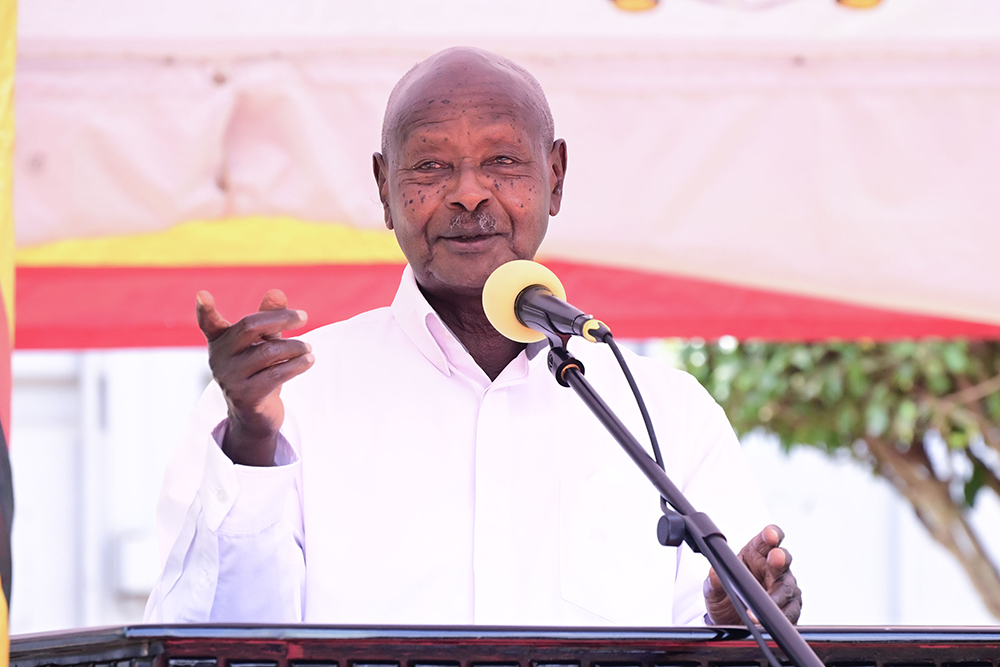
President Yoweri Kaguta Museveni has sharply criticised the late dictator Idi Amin Dada, holding him responsible for the instability and suffering that characterised Uganda during the 1970s. Speaking at the 48th commemoration of Archbishop Janani Luwum at Wii-Gweng in Mucwini, Kitgum District, the President recounted his personal experience of Amin’s January 1971 military coup and outlined what he described as Amin’s fundamental “mistakes” in leadership.
Archbishop Janani Luwum, who was born in Mucwini and served as Archbishop of the Church of Uganda, Rwanda, Burundi and Boga-Zaire, was murdered on 16 February 1977 after he publicly protested against the Amin regime’s policies of arbitrary killings and disappearances. His death, which the government at the time attributed to a car accident despite evidence of gunshot wounds, remains one of the most prominent symbols of Amin’s brutality. The annual commemoration, observed as a public holiday in Uganda, drew thousands of pilgrims and dignitaries to the martyr’s burial site.
Museveni, who was serving as a research assistant in the President’s office at the time of the coup, recalled the events of 25 January 1971 with vivid detail. He told the gathering that he and his colleagues had been deeply engaged in programmes of East African integration and the liberation of African nations still under colonial and white minority rule including Mozambique, Angola, Zimbabwe, and South Africa when Amin seized power.
“On a Monday, 25th, when we were going to work ‘Oh, don’t go to work, there is some problem,’” Museveni recalled. “At around 3 p.m. they announced that Amin had become President of Uganda.”
The President said he immediately convened a meeting of student leaders and declared that they would not accept Amin’s rule. By 27 January, just two days after the coup, Museveni and four companions had crossed into Tanzania to begin organising resistance.
“Idi Amin never ruled me. He ruled me only for a few hours of the 25th and the whole of the 26th. That was the end,” the President declared.
Museveni identified two principal failures of the Amin regime. The first, he said, was the imposition of leadership on the people. Citing both biblical scripture and political philosophy, the President argued that persuasion is always superior to force. He quoted the Bible, urging leaders to “let your light so shine before men that they see your good deeds,” and warned that modern leaders who resort to manipulation and intimidation are repeating Amin’s errors.
The second mistake, Museveni said, was Amin’s reliance on extrajudicial killings and political assassinations. The President drew a firm distinction between combat in battle and the targeted murder of political opponents, describing the latter as cowardice. He recounted how some of his own fighters once proposed assassinating former President Milton Obote in Nairobi in an operation they codenamed “Operation Chicha,” but Museveni rejected the plan outright.
“I cannot find a man in his home and kill him and say I’m a fighter,” Museveni said, adding that both his Christian faith and African tradition regard such tactics as dishonourable.
The President used the occasion to highlight the NRM government’s approach to winning support in Northern Uganda, a region that historically offered limited electoral backing to his party. Museveni noted that the NRM once received as little as 12 percent of the vote in the region, but persisted in delivering services electricity, roads, schools, health centres, and clean water regardless of voting patterns.
He credited these sustained development efforts with the eventual shift in support, likening the change in public sentiment to a parable about a dog that initially mistakes a piece of dried meat for a stone. “After many years, people in the North said, ‘Ah, this NRM loves Northern Uganda,’” Museveni said, thanking the region for its “overwhelming support” in the most recent election.
The President also highlighted the elimination of guinea worm disease in Northern Uganda through improved water supply, describing it as a tangible example of what development without political conditions can achieve.
Looking ahead, Museveni outlined the government’s priority of eliminating household poverty. He reported that the proportion of Ugandans participating in the money economy has grown from just 9 percent at independence to 70 percent today, partly through interventions such as the Parish Development Model (PDM). He pledged to bring the remaining 30 percent into the formal economy.
The President also announced plans to build a commemorative centre at the site to honour Archbishop Luwum’s legacy and develop the surrounding area. He pledged to honour an outstanding commitment of 60 million shillings to the local diocese. He further promised the delivery of two trucks to the area within two weeks and vowed to address lingering cattle rustling in the Karamoja sub-region.
The commemoration served as both a solemn tribute to Archbishop Luwum’s sacrifice and to all those who lost their lives during Uganda’s turbulent past, as well as a platform for the President to reaffirm his government’s commitment to stability, service delivery, and national unity.
Got a Story, Advert, or Announcement?
Onion accepts sponsored content, adverts, and news tips.
📧 Email: [email protected]
📱 WhatsApp: +256 787888277