
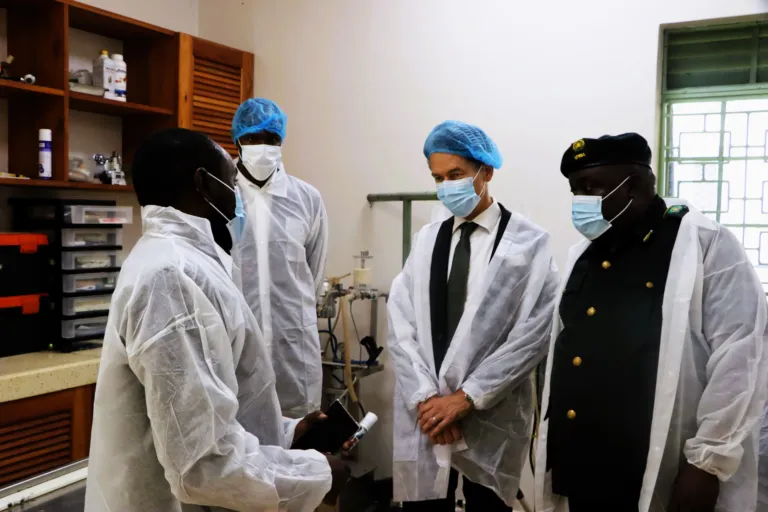
Uganda has officially launched a new Wildlife and Timber Forensic Laboratory in Entebbe, a major step aimed at strengthening the fight against wildlife trafficking, illegal logging and environmental crime.
The facility, which was opened on April 29, 2026 at the Uganda Wildlife Conservation Education Centre (UWEC), will now handle both wildlife and timber forensic investigations, expanding beyond its previous focus on wildlife crime alone.
Authorities say the laboratory will play a critical role in helping investigators and prosecutors build stronger cases against criminal networks involved in the illegal trade of wildlife products and protected timber species.
Using modern forensic science techniques such as DNA analysis, experts at the laboratory will be able to trace seized animal products and timber back to their origins, helping law enforcement agencies connect suspects to crime scenes and provide scientifically verified evidence in court.
The laboratory builds on earlier efforts that began in 2019, when the United Nations Office on Drugs and Crime (UNODC), working with the TRACE Wildlife Forensics Network and the Uganda Wildlife Authority (UWA), established a pilot wildlife forensic facility in Uganda.
Since then, the laboratory has supported hundreds of investigations and prosecutions linked to illegal wildlife trade.
Its latest expansion comes under a UNODC project focused on fighting deforestation and forest degradation through Uganda’s criminal justice system. The project is funded by the European Union under the EU-Uganda Forest Partnerships Programme, with additional support from Denmark.
Officials say illegal logging and timber trafficking are becoming increasingly dangerous forms of organized crime, threatening Uganda’s forests, biodiversity and local livelihoods.
According to reports from the Ministry of Water and Environment, Uganda’s forest cover has dropped sharply over the past three decades, falling from 24 percent in 1990 to about 13 percent in 2025.
The growing pressure on forests has raised concern among conservationists and government agencies, especially as climate change and environmental degradation continue affecting communities across the country.
To support the laboratory’s expanded role, the facility was relocated to UWEC’s National Wildlife Hospital and Quarantine Centre in Entebbe, where new upgrades have been carried out to improve security, infrastructure and international forensic standards.
UNODC and TRACE, together with UWA and the Ministry of Water and Environment, have also supported the installation of specialized equipment, staff training and the development of forensic procedures for handling both wildlife and timber evidence.
Speaking during the launch, Mr Giovani Broussard, the Africa Coordinator for the UNODC Global Programme on Crimes that Affect the Environment, said environmental crimes are often driven by transnational criminal groups operating across borders.
“By strengthening forensic capacity in Uganda, UNODC is helping to close critical evidence gaps, enhance accountability and ensure that criminals who exploit nature for unsustainable profit are brought to justice,” he said.
European Union Ambassador to Uganda Jan Sadek described the laboratory as an important investment in conservation, science and the rule of law.
“This laboratory represents a powerful investment in science, justice and sustainability. By supporting forensic capacity, the European Union is helping Uganda protect its forests and wildlife, safeguard local livelihoods and uphold the rule of law against environmental crime,” Sadek said.
Assistant Commissioner for Forestry at the Ministry of Water and Environment, Bob Kazungu, said science-based investigations would strengthen efforts to combat illegal logging and protect Uganda’s remaining forests.
“Science-based enforcement is a game changer in protecting our natural resources. The Ministry is committed to working closely with partners to ensure sustainable forest management and to stop illegal logging at its source,” he said.
Chief Magistrate Gladys Kamasanyu of the Standards, Utilities and Wildlife Court also welcomed the development, saying the laboratory would strengthen Uganda’s criminal justice system by providing reliable scientific evidence in court.
“When science is applied to the law, the law becomes a more powerful tool for conservation,” she said.
Officials at the launch called for stronger cooperation between scientists, conservation agencies and the justice sector to ensure environmental crimes are effectively investigated and prosecuted while protecting Uganda’s natural heritage for future generations.
Got a Story, Advert, or Announcement?
Onion accepts sponsored content, adverts, and news tips.
📧 Email: [email protected]
📱 WhatsApp: +256 703195271