
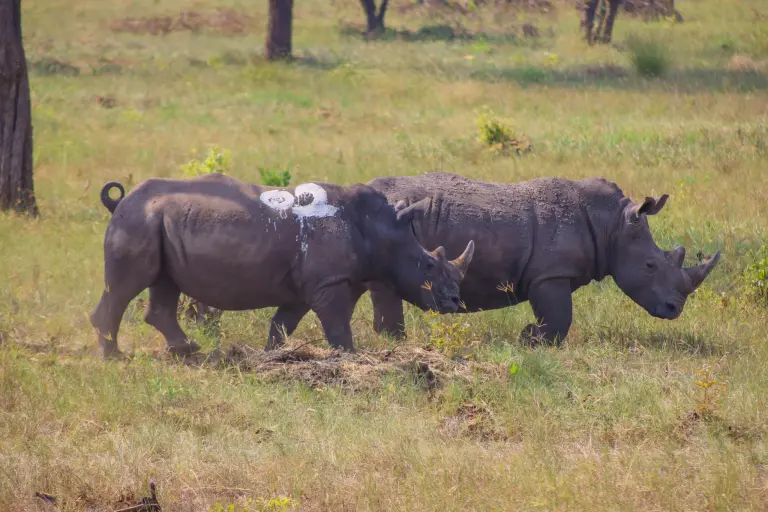
Six weeks after Uganda Wildlife Authority rangers loaded four Southern White Rhinos into steel transport crates and drove them 221 kilometres north from Ziwa Rhino Sanctuary in Nakasongola to Ajai Wildlife Reserve in Madi-Okollo District, the animals are feeding well, moving freely across their new terrain, and being tracked around the clock by dedicated ranger teams who have not left their side since the day they arrived.
It is the most significant moment in Ugandan conservation history since the country’s last wild rhino was killed in Kidepo Valley National Park in 1983, leaving Uganda without a single rhinoceros for the first time in recorded history. Uganda now has 60.
That number matters not just because it is large relative to zero, but because of what it represents: the result of a deliberate, three-decade recovery strategy that began with six borrowed animals on a converted cattle ranch and has grown, without a single poaching loss, into a national programme now expanding rhinos back into the wild across their former range. A 60th was born three weeks ago, the latest proof that the breeding programme continues to deliver.
With 16 more rhinos planned for Ajai and future reintroduction sites already identified at Kidepo Valley National Park and Murchison Falls National Park, UWA is no longer debating whether Uganda can have rhinos in the wild. It is working out how many, and how soon.
“The return of rhinos to Ajai is a proud and emotional moment for Uganda,” UWA Executive Director Dr. James Musinguzi said at the January 12 ceremony where Tourism Minister Col. Tom Butime formally unveiled the animals before representatives of the 15 tribes of the Ajai kingdom. “It reflects years of dedicated conservation work and a highly successful breeding programme at Ziwa Rhino Sanctuary.”
To understand why four rhinos grazing at Ajai carries the weight it does, you have to understand how completely Uganda lost them. The country once held an estimated 700 animals across two species, the Northern White Rhinoceros in the northwest and the Eastern Black Rhinoceros in Kidepo and parts of Murchison Falls. As recently as 1965, Ajai alone held 60 of Uganda’s 80 remaining white rhinos, making it the single most important rhino stronghold in the country.
What followed was systematic destruction. Surging international demand for rhino horn, which fetched up to one million US dollars per kilogram on black markets, drove industrial-scale poaching through the 1960s and 1970s. The Idi Amin era between 1971 and 1979 destroyed whatever wildlife enforcement remained. By 1975, only 19 white rhinos survived in the entire country. The Liberation War of 1979 eliminated most of those. UWA’s own records describe the period as producing “the virtual extermination of white rhinos in Uganda.” The last Northern White Rhino was recorded at Murchison Falls in 1982. The last Eastern Black Rhino died in Kidepo in 1983. Both species were gone, and for 18 years, nobody came to replace them.
The recovery started quietly in 1997 when conservationists formed Rhino Fund Uganda with the explicit purpose of restoring the species. Their plan had three stages: build public awareness, establish a breeding population in a protected sanctuary, then return rhinos to Uganda’s national parks and wildlife reserves. In 2005, Ziwa Rhino Sanctuary opened on 7,000 hectares of converted cattle ranch in Nakasongola, offered by landowner Captain Joe Roy under a 30-year agreement with Rhino Fund Uganda and UWA.
The first animals arrived that same year: four Southern White Rhinos from Solio Ranch in Kenya, followed in 2006 by two more from Disney’s Animal Kingdom in Orlando, Florida. Six animals on a former cattle ranch, surrounded by 45 kilometres of solar-powered electric fencing. That was Uganda’s entire rhino population.
On June 24, 2009, the first healthy calf, a male named Obama after his mixed Kenyan-American parentage, was born at Ziwa. He was the first rhino born in Uganda in roughly 30 years and remains alive today. The population grew from those six founders to 13 by 2013, to 33 by 2021, and reached 49 by late last year. Each rhino family at Ziwa is accompanied at all times by a dedicated two-person monitoring team. Rangers work rotating shifts around the clock. In two full decades, not one rhino at Ziwa has been lost to poaching, a record that is difficult to match anywhere on the continent.
“We want communities to feel that these rhinos belong to them,” UWA Assistant Commissioner for Communications Bashir Hangi said. “When communities are involved, they become an additional layer of security.”
The numbers received a major boost in December when African Parks donated eight Southern White Rhinos from the Munyawana Conservancy in KwaZulu-Natal, South Africa. Four males and four females landed at Entebbe International Airport at 2:30 in the morning on December 9 and were moved under security to Ziwa for quarantine. Their arrival pushed Uganda’s national count to 59, and three weeks ago a new calf born at Ziwa brought that number to 60, the highest in the country’s post-independence conservation history.
“This is a significant boost to our national rhino recovery programme,” UWA Commissioner of Biodiversity Management John Makombo said. Three weeks later, seven UWA rangers who had received specialised translocation training in Kenya loaded four of those animals into reinforced crates and began the four-hour drive to Ajai. The animals are currently in a temporary holding area within the reserve, acclimatising before full release into the wider landscape.
“The idea of moving them in phases is to reduce risk,” Mr Hangi explained. “We want to be certain that everything is stable before proceeding with the next group.” Security at Ajai reflects how seriously UWA is treating the operation. A fenced sanctuary with breach-detection monitoring has been constructed, rangers are stationed permanently on site, and a 30,000-litre water reservoir has been built. Twenty-two families were relocated before the animals arrived to reduce the risk of human-wildlife conflict from the start.
The four rhinos at Ajai are only the beginning. UWA’s National Rhino Conservation and Management Strategy targets 20 animals at the reserve, with 16 more to follow once the current group settles. Kidepo Valley National Park is earmarked for 30 additional rhinos, and Murchison Falls also features in the long-term reintroduction plan.
International financing is being assembled to support that ambition. In December, UWA launched the Theodore Roosevelt Rhino Fundraising Campaign at Uganda’s Permanent Mission to the United Nations in New York, targeting five million US dollars. The campaign draws on the legacy of the 1909 Smithsonian-Roosevelt African Expedition, during which former US President Theodore Roosevelt documented white rhinos in the Ajai area. A young calf at Ziwa will be named Roosevelt at a ceremony planned for October 2026 at Ajai, to be attended by a member of the Roosevelt family. Uganda’s five-year fundraising target across the full programme stands at 11 million US dollars.
Behind the recovery sits an enforcement operation that has been rebuilt from the ground up. UWA now deploys a 14-dog canine detection unit at Entebbe Airport and Murchison Falls, drone patrols, GPS-tagged vultures for aerial surveillance, and the EarthRanger satellite platform giving commanders real-time data across all protected areas. Between 2021 and 2023, UWA made over 3,000 arrests for wildlife crimes and secured 396 convictions. Rangers have pulled more than 28,000 wire snares from Murchison Falls National Park alone.
The animals at Ajai are Southern White Rhinos, not the Northern White or Eastern Black species Uganda originally lost. The Northern White is now functionally extinct worldwide, with only two females surviving in Kenya. Conservationists have accepted the Southern White as the only realistic alternative, filling the same ecological role across the landscape.
For a country that spent four decades with no rhinos at all, the sight of four animals settling into the grasslands of Ajai is not a footnote. It is the whole point of everything that came before it, and the starting line for everything that comes next.
Got a Story, Advert, or Announcement?
Onion accepts sponsored content, adverts, and news tips.
📧 Email: [email protected]
📱 WhatsApp: +256 703195271