
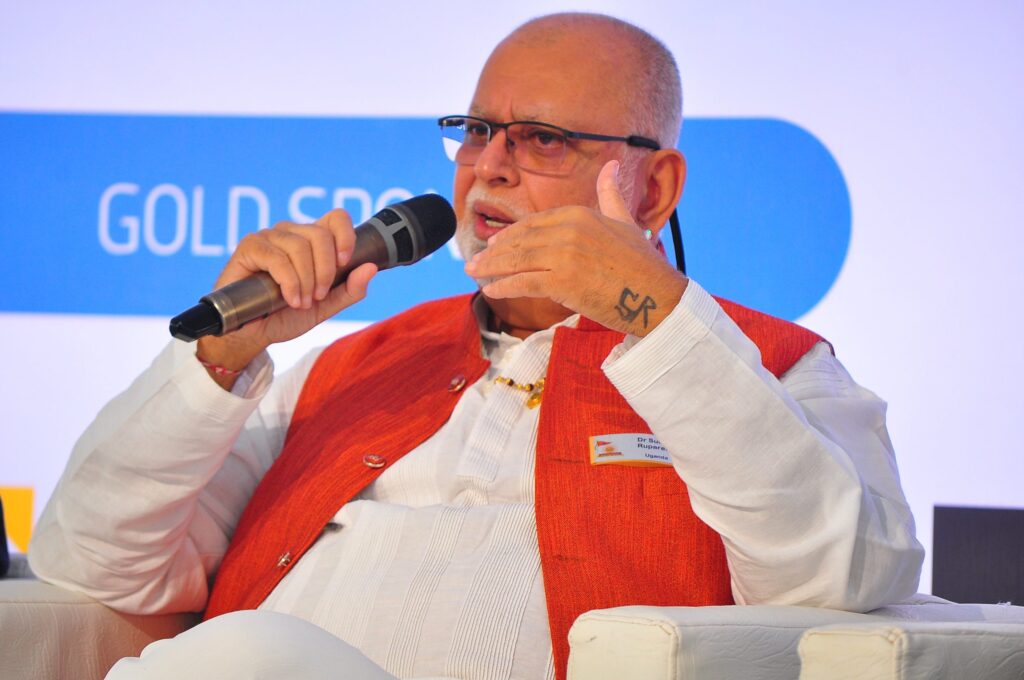
Sudhir Ruparelia has opened up about the scale of his business empire, sharing details about its tax contributions, workforce, and role in Uganda’s broader economic story.
Speaking during a wide-ranging conversation at Crane Chambers, the businessman reflected on decades of investment across multiple sectors and what he believes private enterprise means for national development.
Ruparelia said his businesses collectively employ more than 10,000 people, pushing back against the notion that large investors crowd out employment opportunities. In his view, they do the opposite, creating jobs at scale across industries that require serious, long-term capital commitment.
He also spoke about Uganda’s Asian business community, estimating that roughly 30,000 Ugandans of Indian origin live in a country of about 50 million people. Small in number, he argued, but significant in their contribution to investment, taxation, and industrial output. He noted that many Asian-owned businesses operate in sectors like manufacturing, hospitality, real estate, and services, areas where sustained investment tends to generate wide economic ripple effects.
On taxation, Ruparelia was direct. He described paying taxes as both a legal duty and a contribution to national progress. He revealed that one of his companies alone pays around Shs2.5 billion in VAT every month, adding up to roughly Shs30 billion annually. He also said he is among Uganda’s largest taxpayers in the real estate sector, contributing over Shs12 billion in taxes and a further Shs9 to 10 billion in VAT personally. His businesses also remit withholding tax, employee deductions, and other statutory payments across their operations.
He credited the group’s sustained growth to financial discipline and structured management. The Ruparelia Group spans real estate, education, hospitality, and floriculture, each division supported by dedicated accounting and administrative teams. A key principle, he said, is keeping financial administration separate from operational management so that each function can perform without interference from the other. Using schools as an example, he said administrators should be focused on teaching quality while financial systems run independently in the background.
On a more personal note, Ruparelia said he only invests in things that genuinely interest him, and that passion remains one of the most reliable drivers of long-term success. At 70, he keeps a simple morning routine, starting the day with coffee, fruit, or biscuits as part of a health-conscious lifestyle.
Away from business, he serves as Nepal’s Honorary Consul in Uganda, a role he described as unpaid and centered on supporting diplomatic ties and assisting Nepali citizens in the country.
He also reflected on Uganda’s economic transformation over the years, pointing to growth in infrastructure, manufacturing, and property values. He noted that local production has expanded considerably, with many consumer goods now made domestically that were once imported. In his view, the combination of indigenous traders and investors alongside other business communities has helped fuel that growth over time.
The conversation ended on a deeply personal note. Ruparelia spoke about his late son Rajiv Ruparelia, remembering him as a driven young businessman whose presence was widely felt in Uganda’s commercial landscape. A commemorative event is planned for August 29 at Speke Resort Munyonyo, organized by Pan African Pyramid, to celebrate Rajiv’s life and legacy.
For Ruparelia, his journey from refugee to one of East Africa’s most prominent private sector figures remains inseparable from Uganda’s own economic story, built on investment, discipline, and a long-term belief in the country’s potential.
Got a Story, Advert, or Announcement?
Onion accepts sponsored content, adverts, and news tips.
📧 Email: [email protected]
📱 WhatsApp: +256 787888277