
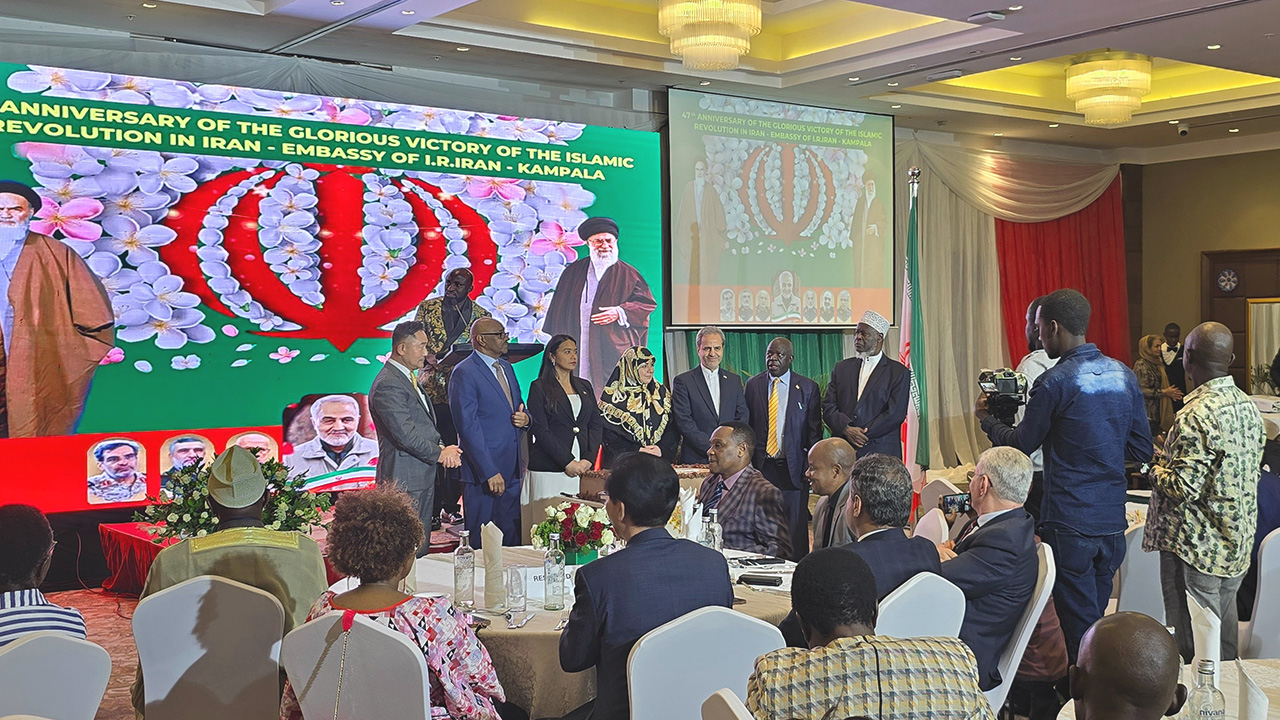
Uganda and Iran have renewed their commitment to expand trade and economic cooperation, with officials from both countries admitting that bilateral trade remains modest despite decades of diplomatic engagement.
The remarks were made on Monday at a dinner reception hosted by the Iranian Embassy at the Sheraton Hotel in Kampala to mark the 47th Anniversary of the Islamic Revolution. The event attracted senior government officials, diplomats, legislators, and representatives of international organisations.
Mr Majid Saffar, the Iranian Ambassador to Uganda, said the two countries are natural partners and confirmed Iran’s willingness to cooperate with Uganda in agriculture, agro-processing, energy, and technology transfer.
“Our goal is not to create dependency, but to empower,” he said, adding that Iran is ready to share expertise in mechanized farming, food processing, hydropower, and digital technologies to support Uganda’s development ambitions.
Mr Saffar also spoke about the 1979 Islamic Revolution, describing it as a turning point that restored Iran’s sovereignty.
“For 47 years, the Islamic Republic of Iran has pursued a path based on independence and rejection of foreign domination,” Ambassador Saffar said, noting that Iran has made scientific, economic, and social progress despite sanctions.
He pointed to Iran’s advances in nanotechnology, biotechnology, aerospace, and pharmaceutical production, which he said were driven by local innovation and investment in human capital. He also said Iran has been working to diversify its economy away from oil dependence.
Amb. Dr Mohammad Ahmed Kisuule, the Senior Presidential Advisor on Middle East Affairs, who represented the government as Guest of Honour, delivered congratulations from President Museveni to Iran on the occasion.
“Uganda values the relations it enjoys with the Islamic Republic of Iran, founded on mutual respect, dialogue, and cooperation,” Dr Kisuule said.
He said Iran has contributed to Uganda’s development in health services, pharmaceuticals, education, and technical training. He also noted progress in agricultural cooperation, including technology exchange, mechanisation, irrigation, and value addition.
Dr Kisuule, however, acknowledged that trade between the two countries is still low and called for renewed engagement through joint commissions and business-to-business partnerships to tap into the potential for growth.
Trade between Uganda and Iran has historically been weighed down by Western sanctions imposed on Tehran. During the late President Ebrahim Raisi’s visit to Uganda in July 2023, the two countries signed four agreements covering visa waivers, agriculture, and the establishment of a joint permanent intergovernmental commission.
President Museveni has in the past proposed barter trade with Iran to work around the sanctions regime. In 2009, he visited Tehran and invited Iranian investors to build an oil refinery in Uganda, a move that reportedly irked Washington.
Iran is among the world’s most sanctioned countries by the US and the European Union, alongside Cuba, North Korea, and Russia, among others.
At the multilateral level, Dr Kisuule noted that Uganda and Iran hold common positions within the Non-Aligned Movement (NAM), which Uganda currently chairs. Both countries advocate for dialogue, sovereignty, and peaceful resolution of disputes.
The event ended with both sides calling for stronger South-South cooperation.