
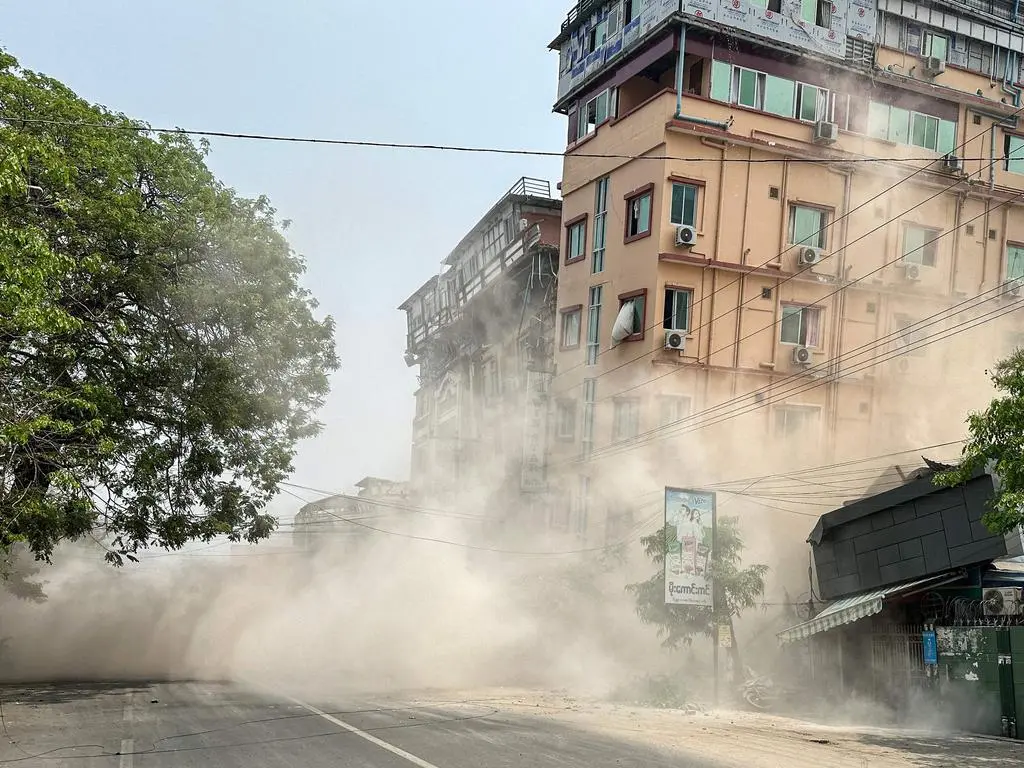
A powerful earthquake measuring 7.8 on the Richter scale has left at least 35 people dead after shaking large parts of southern Philippines early Monday morning.
The quake struck off the coast of Mindanao at around 7:37 a.m. local time, sending residents rushing out of homes, schools and offices as buildings swayed violently. Authorities immediately issued tsunami warnings across several countries in the Pacific region, including the Philippines, Indonesia, Japan and Australia. The alerts were later downgraded or lifted after further assessments.
Rescue teams have been deployed to affected communities where collapsed structures, damaged roads and landslides have complicated emergency operations. Videos shared online showed scenes of destruction, including a popular fast-food restaurant reduced to rubble after the earthquake.
According to the Philippines’ Office of Civil Defense, most of the fatalities were recorded in the Soccsksargen region, while additional deaths were reported in nearby Davao. More than 130 people have been injured, and thousands of families have been forced to leave their homes due to damage and safety concerns.
Authorities are still verifying casualty figures, with reports indicating that several people remain unaccounted for. Disaster management agencies continue to gather information from local governments to establish the full scale of the tragedy.
Philippine President Ferdinand Marcos Jr. assured affected communities that the national government would provide support during recovery efforts. He said government agencies had been mobilized to coordinate rescue operations, deliver relief supplies and assess damage across the region.
The earthquake also disrupted the reopening of schools in some areas. Classes were suspended in several provinces as officials inspected buildings for structural damage. In one widely shared video from Davao Occidental, frightened pupils were seen crouching on open ground while strong tremors shook the area. A nearby shelter later collapsed, although no injuries were reported at the school.
Seismologists recorded more than 130 aftershocks following the initial quake, some of them strong enough to be felt across affected provinces. Another significant tremor struck near Balut Island later in the evening, adding to concerns among residents already dealing with the aftermath of the disaster.
The earthquake triggered tsunami concerns across the region. Japanese authorities initially warned that waves of up to one metre could reach parts of the country’s coastline. Smaller waves were later detected in Okinawa and other islands, while tsunami activity was also observed in parts of Indonesia, Palau and the Philippines.
Mindanao, the country’s second-largest island, is home to roughly 26 million people and has experienced several major earthquakes in the past. The Philippines lies along the Pacific Ring of Fire, one of the world’s most active seismic zones, making earthquakes a frequent occurrence. While many tremors cause little damage, stronger quakes have repeatedly resulted in loss of life and widespread destruction.
Emergency crews remain on the ground as search and recovery efforts continue, with authorities warning that aftershocks could persist for several days.
Got a Story, Advert, or Announcement?
Onion accepts sponsored content, adverts, and news tips.
📧 Email: [email protected]
📱 WhatsApp: +256 787888277